Moments on Lake Ozette

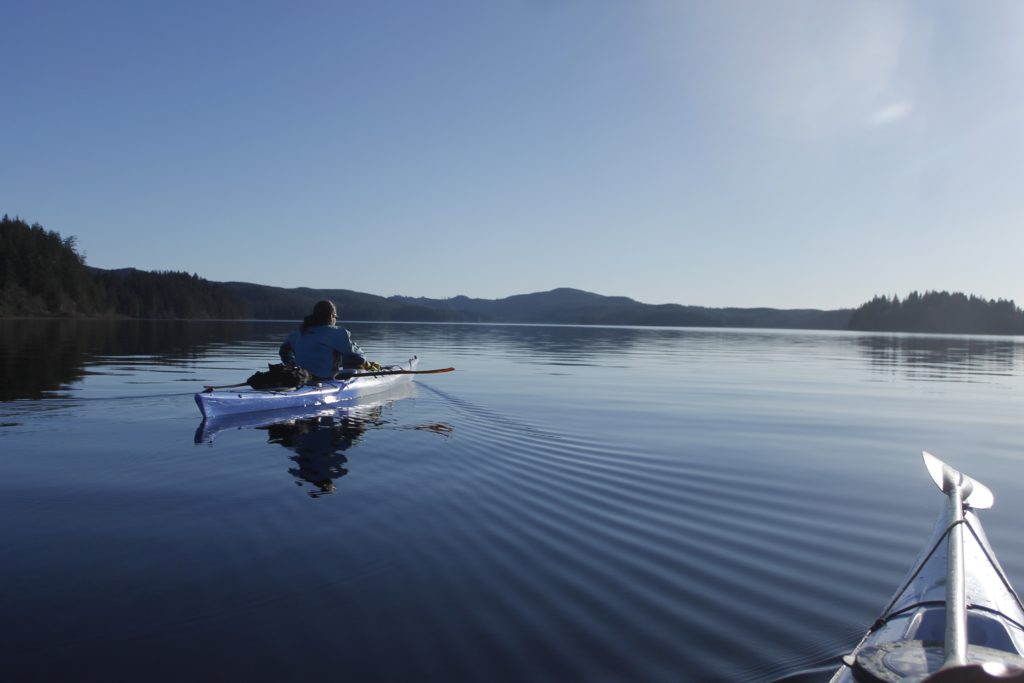
Jarrett paddling on Lake Ozette

Some January day.

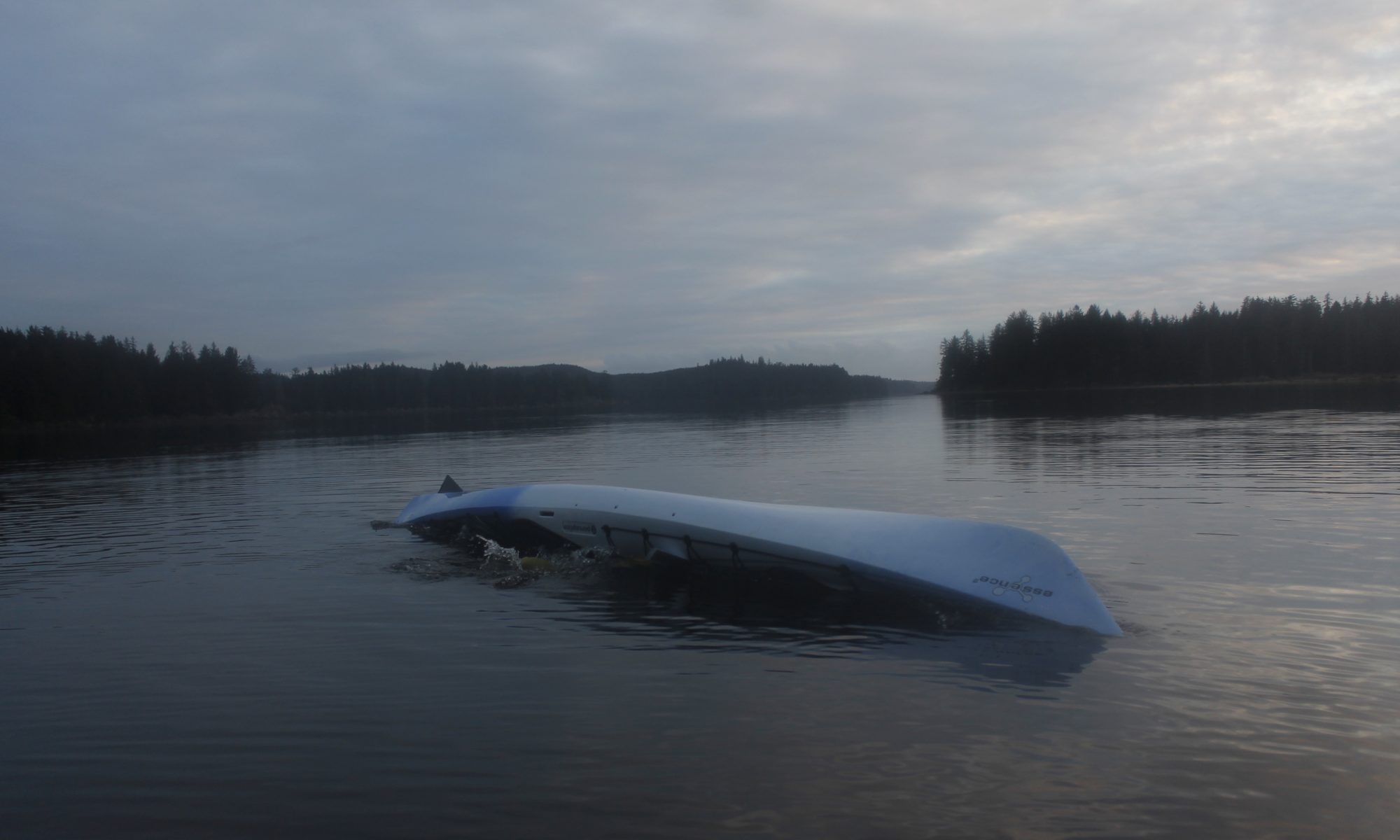
Jarrett and I stood amidst gear and kayaks on the shores of Lake Ozette — the biggest lake in Olympic National Park, at the north-westernmost corner of Washington, about to launch an overnight trip.

And lo! The sun was hot on my arms. Insects were flitting about. I felt, maybe a little bit silly, that I had brought the drysuit, neoprene sprayskirt, various and sundry items of hardcore cold water adventure.

This was warmer than half of the trips we had guided this summer.

“I can’t believe I went skiing yesterday,” I said.

The chest deep powder at Hurricane Ridge was a couple hours drive away, but was worlds removed from this all-too-pleasant lake front. The water was glass.
Jarrett wanted to know if I had brought sunscreen. I hadn’t. Psychologically, I’d been preparing for wind-whipped waves and sleety rain, not the possibility of a tan.

Jarrett slipped into his drysuit so that he could comfortably launch his kayak in the cold water. I was no mood to steam cook myself in Gore-Tex, and opted for shorts and a thin synthetic layer beneath my life vest.

No one said “Climate Change,” but on such an aberrant day, how could you not think about the warming planet and the new realities that it will impose upon our lives.

January might yet become the best season for kayaks.
And it will be just as well, because at least there will be something to do as skiable snow goes the way of the dodo.

Note to up and coming outdoor business owners: Maybe it’s time to start phasing out the skis. Kayaks will have the edge soon enough.

The snow will just keep shrinking up the mountains. Meanwhile, exciting new waterways are going to open up in low-lying places like Florida, Louisiana and New York City. Sure, the water may be a sludge of sewage, decay and industrial effluvia, but as long as the pH doesn’t get low enough to melt boats, you will probably still be able to float over it.

Think about the windfalls awaiting the entrepreneur who sets up the first guided kayak tour through Lower Manhattan.

“And this is the old New York Stock Exchange, where the short-term greed and willful ignorance of investors, abetted by a complicit government, helped bring the Great Flood. Hey, who wants to hit the snack raft for a New York pretzel?”

No one else had gotten the memo about the perfect weather it seems, because there were no other boats that we could see, no other vehicles at the boat launch into Swan Bay.

Jarrett launched first onto the smooth blue water. I made a couple adjustments to my gear and paddled after him. Within a couple minutes, I caught up to him. He had gravitated to a small shady spot behind some trees, where he’d have relief from the sun.

“You see that?” He gestured lazily.

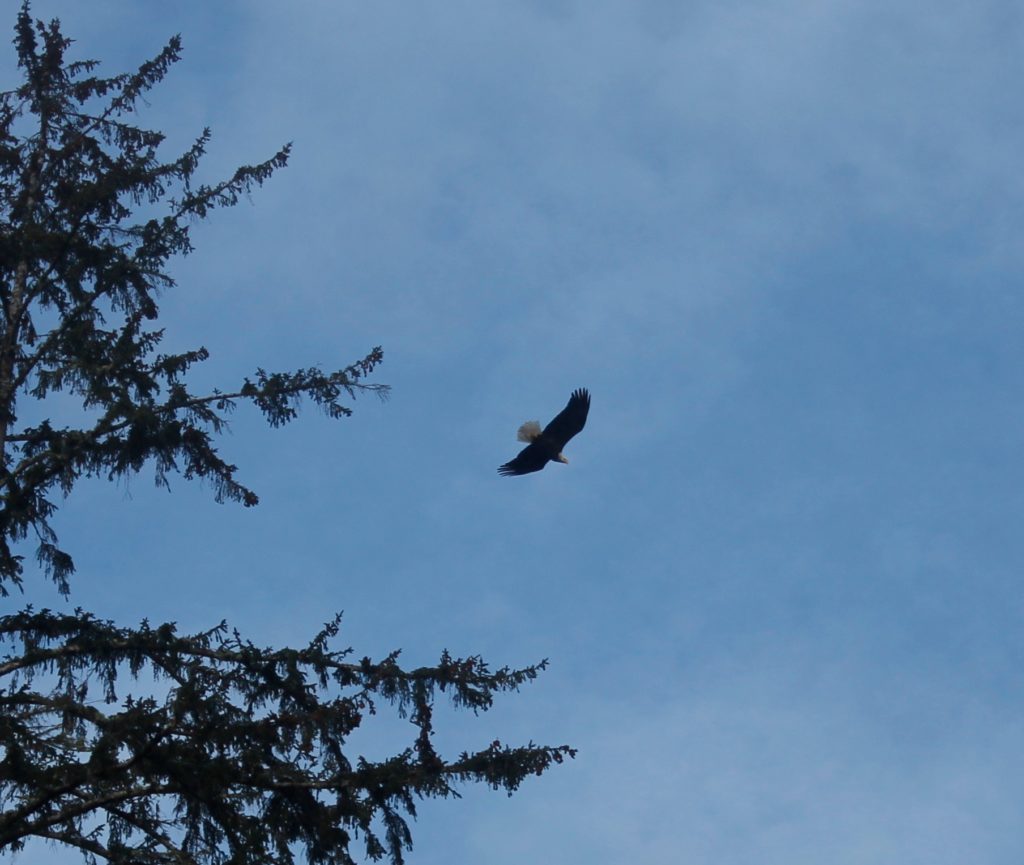
A bald eagle perched in the branches above, scanning the water with its watchful eyes. It would be the first of many eagles we saw on the trip.

“I’m glad you got us out here,” I said.


The trip idea started less than 24-hours ago, when I’d called Jarrett to ask if he’d wanted to hit the water for a day. He was watching football, and said he’d call me back. When my phone rang again, I half-expected to hear that he’d be busy.

“You want to do an overnight on Lake Ozette?”

“Tomorrow?” I asked.

“Yeah.”

“Hell yeah!”

Lake Ozette had been on his to-do-list for a while, partly because you can combine the paddle with a two-mile hike over to a remote beach on the Pacific Ocean. I was stoked to some kind of combination adventure. Moreover, I had a strong itch to get out of town for some time away from the hellish news cycle and a fuzz of wintertime blues.
On the road, the dark clouds around Port Angeles began to melt off. Within 45 minutes, there were blue skies overhead. Highway 112 took a serpentine route along the Strait of Juan de Fuca through a series of hairpin turns and jackknife hills. The mountains of Vancouver Island to our north glimmered with sunlit snow.

“Whooo! That’s beautiful.”

“I can’t believe this weather.”

“Awesome!”

Led Zeppelin on the stereo was the perfect compliment to our buoyant spirits.

“It’s been a long time, been a long time, been a long time!”

Indeed. I hadn’t been in a kayak since November.

The highway would continue out toward Neah Bay and Cape Flattery, on the northwestern-most tip of the continental U.S.

Before we reached this juncture, we hung a left onto a little-traveled backroad. Trees, thick with moss lolled over silty creeks. It was life-on-life, Washington’s bayou country.

Boxy metal gates blocked gravel roads that accessed logged out hillsides. We entered the National Park a couple hundred yards away from the boat launch.

Only half the lake shore is public land, and several logging cuts are visible from the water. I was grateful for the sparse number of houses.

The still water and the lack of people made it possible to perceive subtle cues from the environment.

As Jarrett and I paddled out of Swan Bay into the broader lake, we heard the distant sound of breaking waves. It was the Pacific Ocean — close to two miles off the west shore, but sounding close enough to be just over the next rise. The tumult of countless breakers blended into a white blanket of shushing, thundering agitation as thousand-mile swells threw themselves against the continent.

What a contrast to the miles of stillness we saw before our bows. A loon cried out from somewhere.

“Man! I am sweltering inside this drysuit.” Jarrett announced.

“That’s funny. I feel just about perfect right now,” I said. “This shirt and shorts are breathing great.”

“Have you felt the water yet?” Jarrett asked. I dipped my hand in, and it was icy.

“If someone were to tip you over right now, you’d wish you were in a drysuit.”

I made no further comment and gave Jarrett’s boat plenty of room.

Off of Tivoli Island’s south side

We steered around Garden Island and Preacher’s Point. Many of the names on the map recalled the Scandinavian settlers who lived here in the 19th century. Often they paddled boats made by the nearby Makah tribe. Excavations have recovered human habitation in the area going back 2,000 years.*

No sign of those past inhabitants now as we paddled our plastic boats over the still water. We set our sites on Tivoli island, a couple miles down the way, where we thought we might camp. Sure enough, there was a well established site on the north end of the island with firewood lying on shore.

We paddled a quick loop around to the island’s south side to see if there were any spots that still had the sun, but no dice. Jarrett was down to see about sites on Baby Island, about a mile off, but I felt like we had a pretty good thing on Tivoli and voted that we start getting things set up sooner rather than later.

A dim realization had begun to rattle my confidence, as I thought about what I had (and hadn’t) packed.

I took out my dry bags and the bear canister. There was my stove. Ah, but where was the fuel? I remembered that I decided to take the fuel canister out of the can to save space and pack it elsewhere. Unfortunately, I’d failed to follow through on that last important detail.

“So how do you feel about a cook fire tonight?” I asked.

“Sure, but we can just use your stove,” Jarrett said.

“Well, you see what happened was…”

Jarrett might have been a bit annoyed, because I’d told him he didn’t need to bring his stove. Nope, Tom had it covered.

“Good thing we aren’t in the mountains,” Jarrett muttered. “You said you were going to bring your stove.”

I lamely pointed out that I had brought the stove; it was the fuel that I’d left in the car.

“No sweat. I’ll get a fire going no problem,” I said. I knew it was going to be a pain in the ass getting that fire started.

Sure there was wood everywhere, but most of it was damp. The grim reality I’ve encountered is that campfires on the Olympic Peninsula require generous amounts existential struggle and smoke inhalation.

I started by cutting up sections of logs and shaving wet bark from dead twigs with my knife.  After 45 minutes of gathering, I had sorted out various-sized piles of wood and arranged a cross-hatched nest of tiny twigs for kindling. Everything looked nice and boy scout-worthy. Now, the fun part.

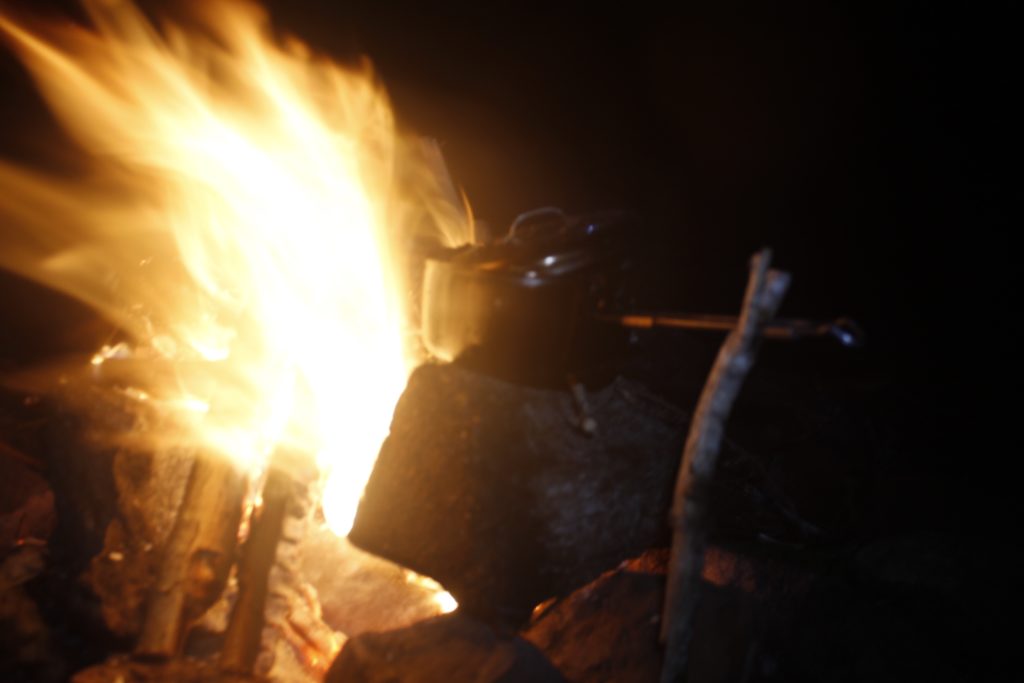
I brought out one of my cotton balls soaked in petroleum jelly, ignited it with flint and steel, and used a stick to nudge it below my twig pile. Orange flame leapt up promisingly. The twigs were burning! The flames climbed higher, and I realized that the twigs were already almost all burned over now. Not what I wanted.

I threw more tiny twigs onto the pile, trying to get them over the fading licks of flame before they went out.  More tiny twigs. I started blowing desperately. Smoke was everywhere. I put my face to the ground to inhale from the puddle of clean air and rose back to the dying blaze for fire CPR. The twigs began burning again, and I tried to get some thicker, longer-burning twigs on the scene. They wouldn’t light of course.

My reputation was on the line and I was not going to let cold dinner be on me.
] I teased more tiny twigs into place. Tentative progress. Breathed the smoke. Cursed the fire. Blew more. Cheered as the the flames climbed up again. Tiny twigs. I cursed the fire, as it seems to change its mind. Blew on the fire. Applied bigger twigs.

As soon as I had flames that lasted more than 20 seconds, I grabbed a pot full of water and held it over the blaze.

“Or we could just use my stove,” Jarrett offered.

“You brought your stove?” I practically exploded.

“I thought I’d mentioned that.”

“Well, now that I’ve got this going, we’re damn well cooking over this fire.”
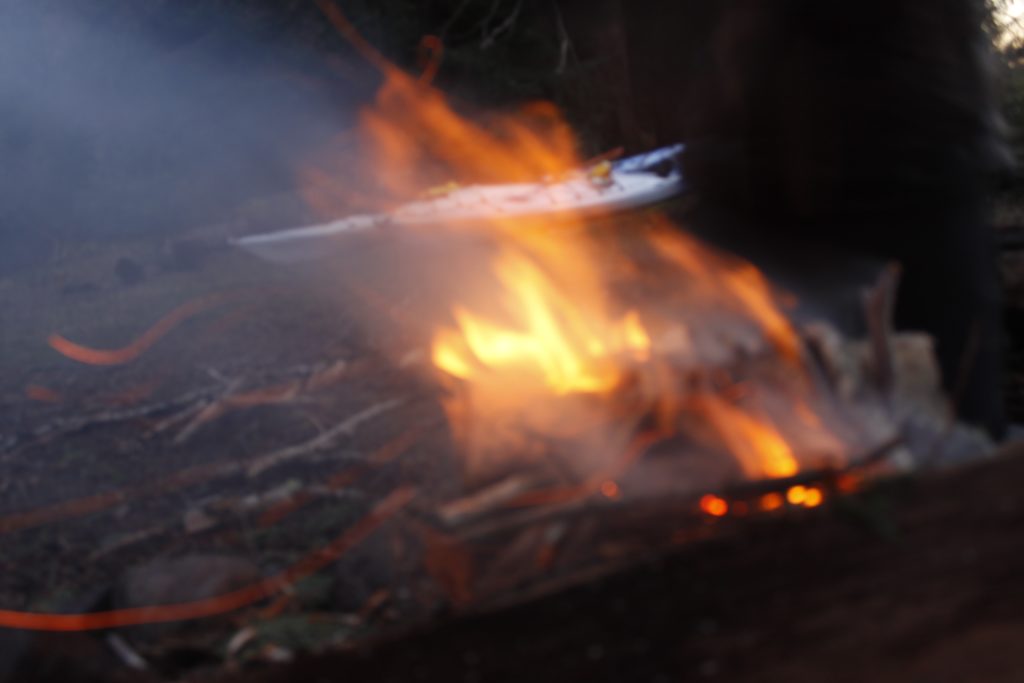
A fire with kayaks
And with dinner cooking

Because the bear can (mandated by the Park Service) only made room for my smallest pot, the meal was multiple courses, including pasta with bouillon cubes, an instant cup of pad thai, and some Spanish rice — with parsley garnish, fattened by the small canister of oil I’d brought along.

Jarrett took over fire duties, transforming my humble cook fire into a hearty camp blaze.

Venus flashed onto the scene first, leading the charge of the starlight brigade. Stars upon stars popped into existence above our fire — little sparks, the fine dusting of cosmic flame traced across the firmament.

The lake caught them, showed the sky its reflection. Even that still, dark water could not master the subtleties of heavenly detail. And I suppose it is the same with us, whether we aim our camera lenses skyward or try to encapsulate profundities with language. The thing itself, the present moment, holds the richest detail.

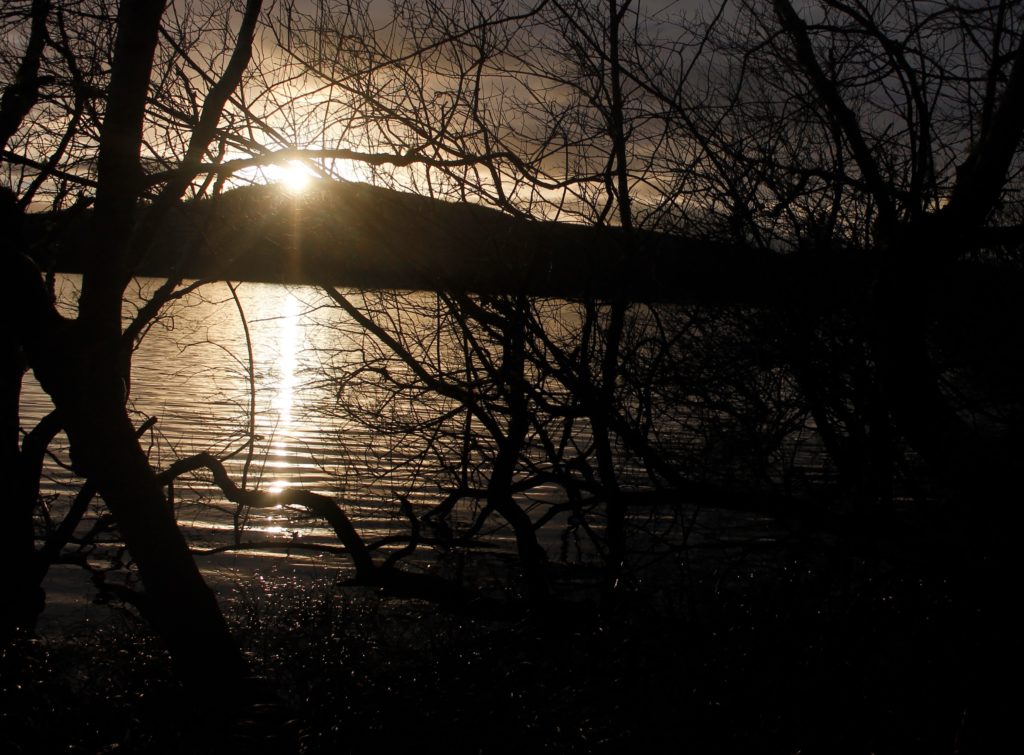
Earlier, I had watched the shifting gradients of color on the lake as the sun went down. Green blue in the west marched, seamless to the deep dark blues on the eastern shores. Wavelets crisscrossed themselves at the corner of the island, came to shore in the shape of diamonds. Gravel had moved away from this little place of interference and left a corridor of bare sand.

These and many other tiny aspects of the dynamic scene in front of me, danced inside my mind, which suddenly seemed a much bigger place than the night before, when I had been reading articles off a computer screen. The world seemed vaster and more full of possibilities.

And yet, the sunlight would banish the celestial tableaux from the lake’s surface. The delightful feeling that I had stepped closer to reality would also fade. It was an appreciation that required repetition, like Sunday Mass. If one can only fully appreciate the stars while under them, it is important to maximize that time.
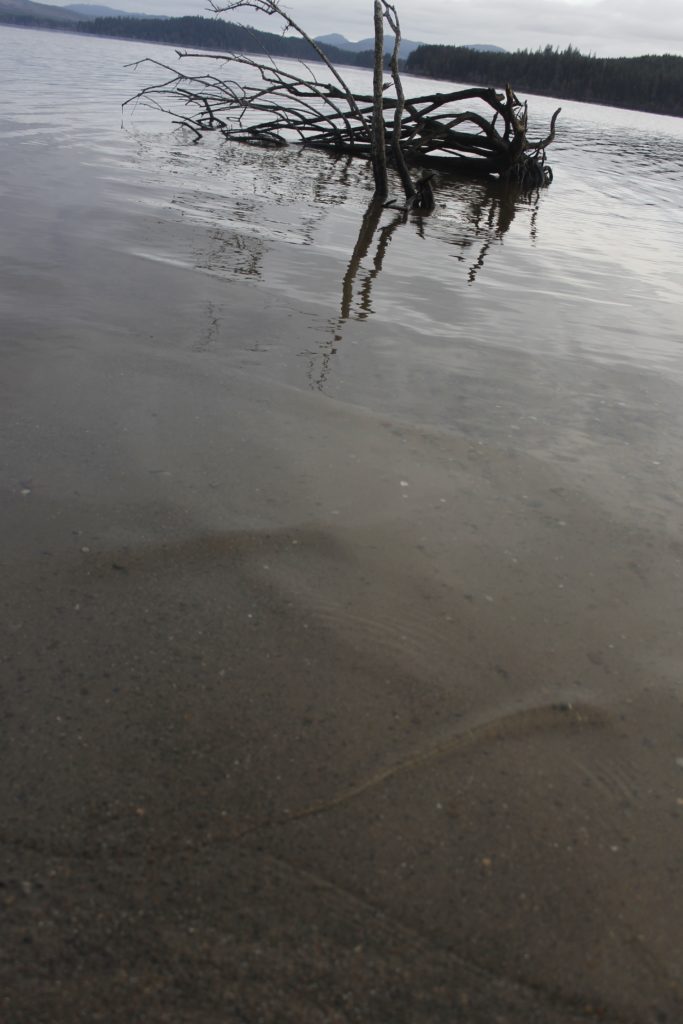
Crossing wavelets bend around a snag in the lake
 Sunrise brings glitter paths to the lake surface
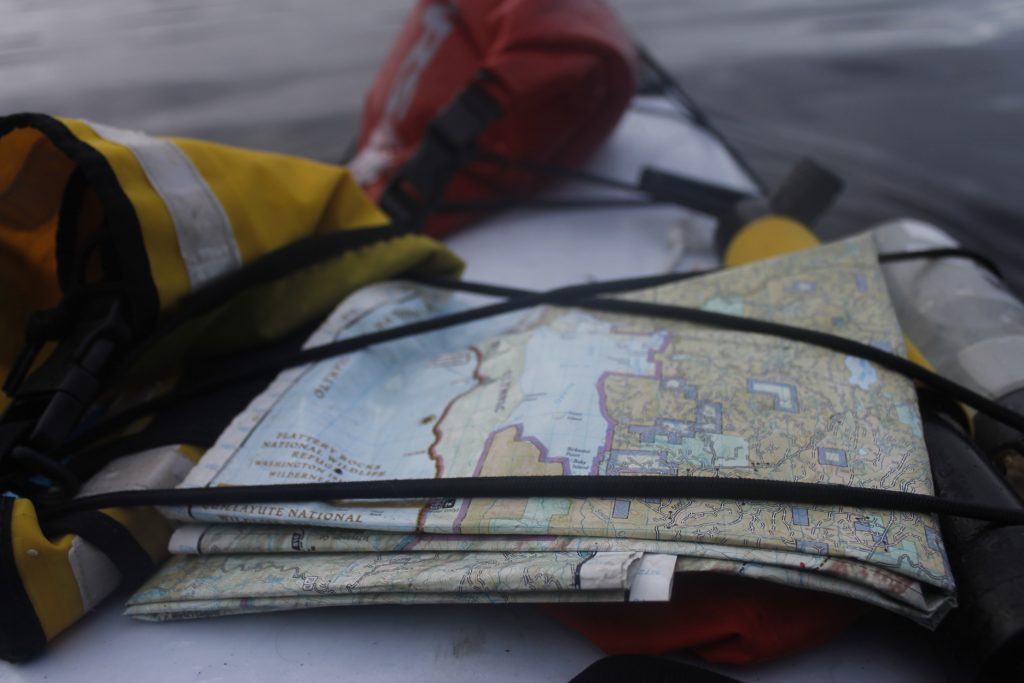
Kayak deck-mounted map showing Ozette and the nearby Pacific Ocean

Morning came with cloudy skies. It wasn’t raining, fortunately.

I went out to get the bear can holding our food. You wouldn’t expect the bears to be out in January, but I learned later that the bears on the part of the Peninsula didn’t really hibernate, because it never got deep cold. A local at a diner explained that the island had been visited by forest creatures. During calving season, local deer would swim out there to give birth, hoping to escape predators. But at least one bruin had gotten wise. The man had seen it swimming out there — probably with a hankering for some tender venison.

Sure enough, there were fresh deer tracks along the shore, but no sign, fortunately, of bears.

We made oatmeal with Jarrett’s stove, packed down the tent, loaded our boats and hit the water.

There was a strait shot across the water to where we would find our trail to the Pacific. Jarrett suggested we cut in a little sooner so we could paddle up the shore. In doing so, we saw what was easily a dozen bald eagles.

They perched in the branches of pines looking at the water. A couple of them took off as we got closer. Several were juveniles, lacking the distinctive bald head and white tail feathers and flashing white and brown beneath their wings. I thought back to January paddles with my dad and others on the Connecticut River, another place that draws eagles in wintertime.

Other signs of animal life included beaver-chewed branches along shore.

A sudden scurrying in the branches caught my attention. A small dark creature was running down the tree.

“Jarrett!” I hissed. “Come here and see this!”

By the time he had paddled up, the creature had vanished.
Eagle in flight
Perched Eagle

“It must have been a fisher cat,” I said. There has been a Park reintroduction program for these cagey weasel creatures, once hunted out of the Olympic Range. They are not something you spot often, and in fact, this was the second fisher, I’d seen in my life. The first time was in high school when I was running through the woods in Connecticut.

After I found out what a fisher was, I developed a respect for the little scrappers. They are tough, and will even go after porcupines.

Later, it occurred to me that I might have seen a bear cub, not a fisher. Still, the agility of the creature stuck out in my mind, and it may have been small for a bear cub this time of year. I believe that it was a fisher I saw in that tree.

The trailhead we wanted was in Ericson’s bay at the northwest corner of the lake. A small orange marker showed us where to park our boats.

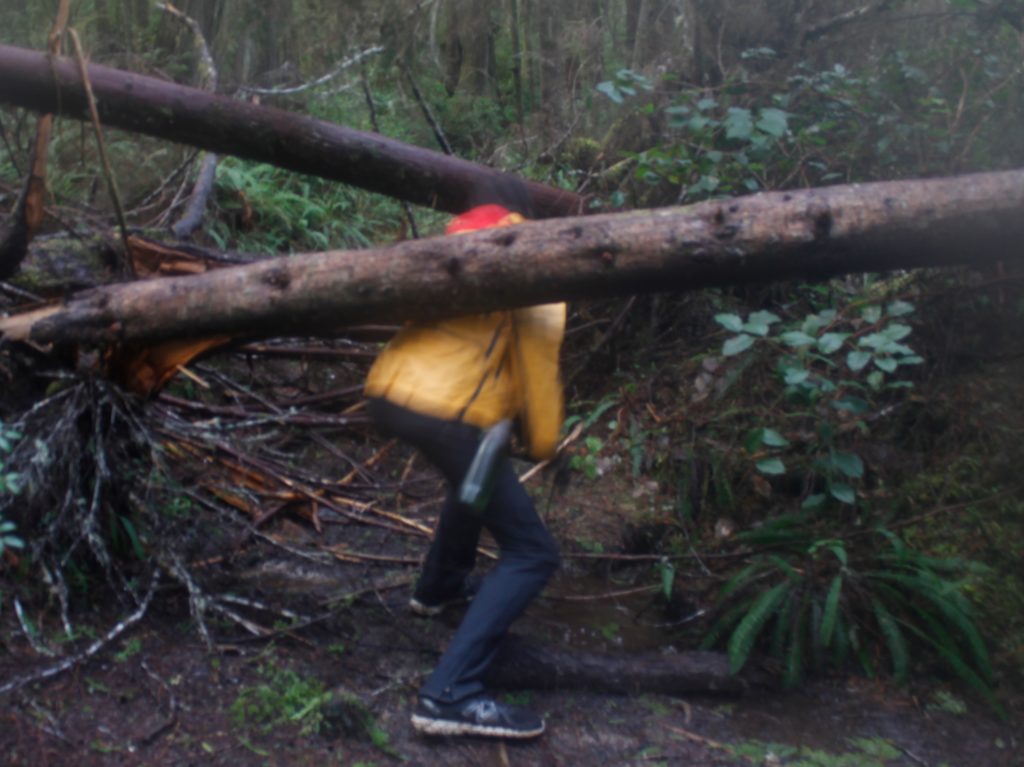
We traded life vests and neoprene booties for sneakers and rain jackets. The rainforest trail was closed in by sword fern and salal shrub. A line of rotting boards offered a place to walk over the mud and soaking moss. The slick wood was as treacherous as black ice. We pushed our way through the salal, over and under fallen trees, put our feet through the oozing ground. Hemlocks, firs and giant cedars closed in  above our heads.
 

Trail challenges
The “dead end” is where our kayaks were

An hour of tromping gave way to an opening where we could see the gray waves of the Pacific.

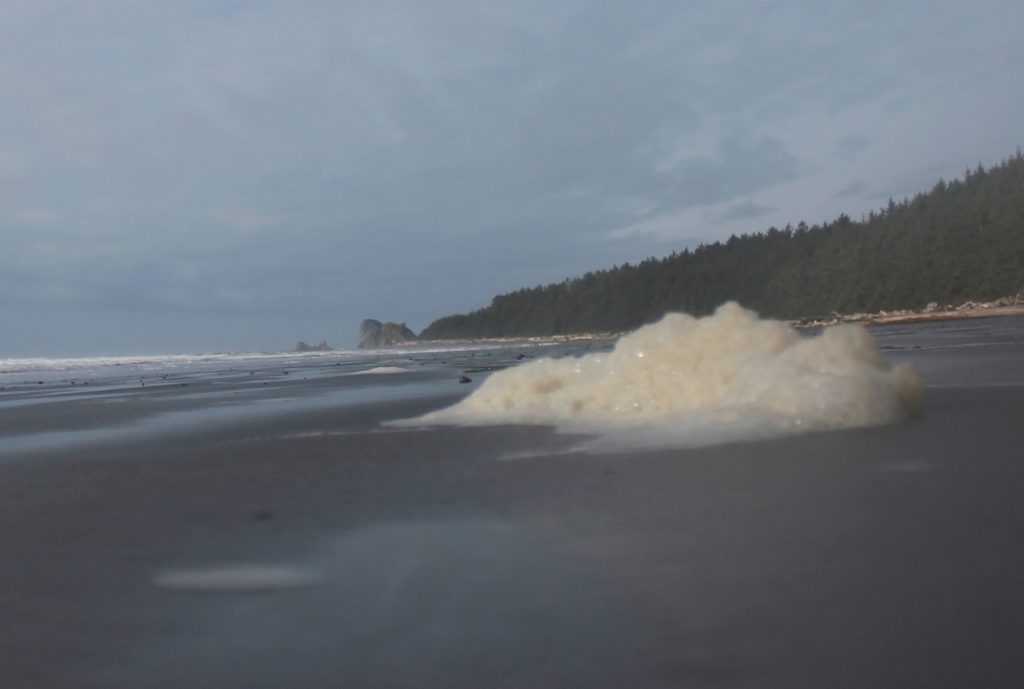
Miles of lonely beach stretched to our north and south. Rock escarpments rose up in the distance. There was only one other hiker on the beach. He probably came in from a different trail and was far off anyhow. Another eagle cut through the sky overhead.

We ate a light lunch on a log. I went to mess around at the edge of the foamy waves.

There were so many patterns from nature here, including the lines of the waves, pods of bubbles, the arrangement of the small rocks along the sand, and the lines and dips that that the water carved around them.

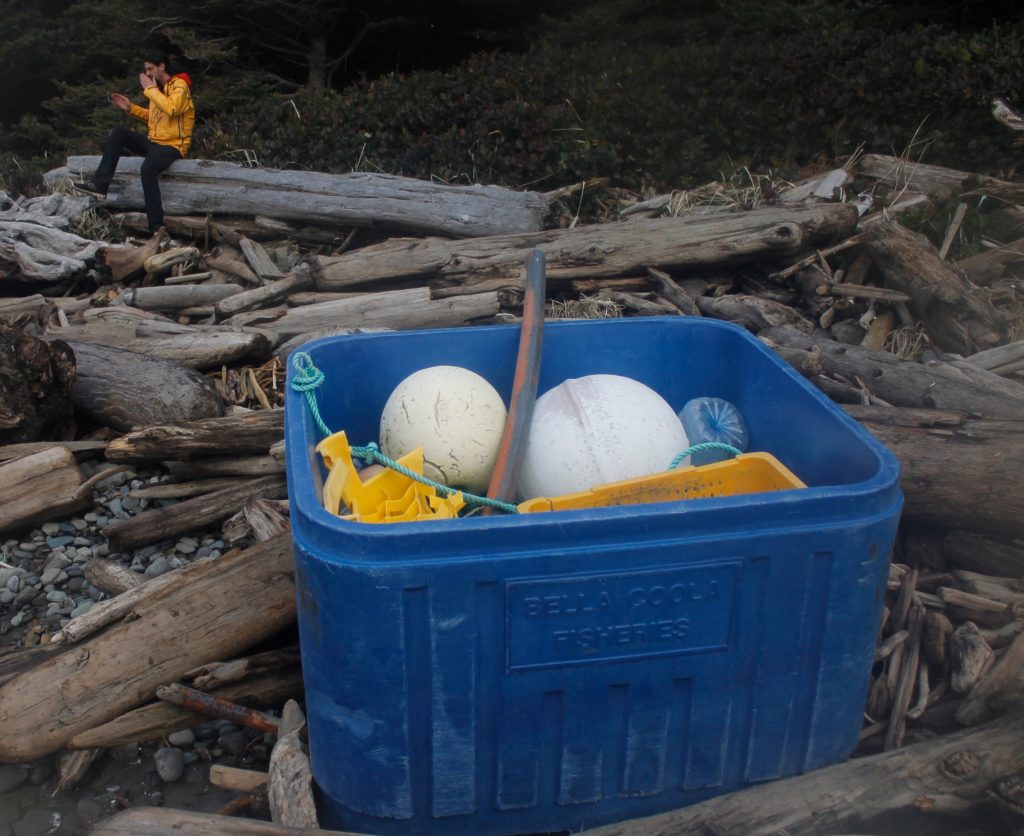
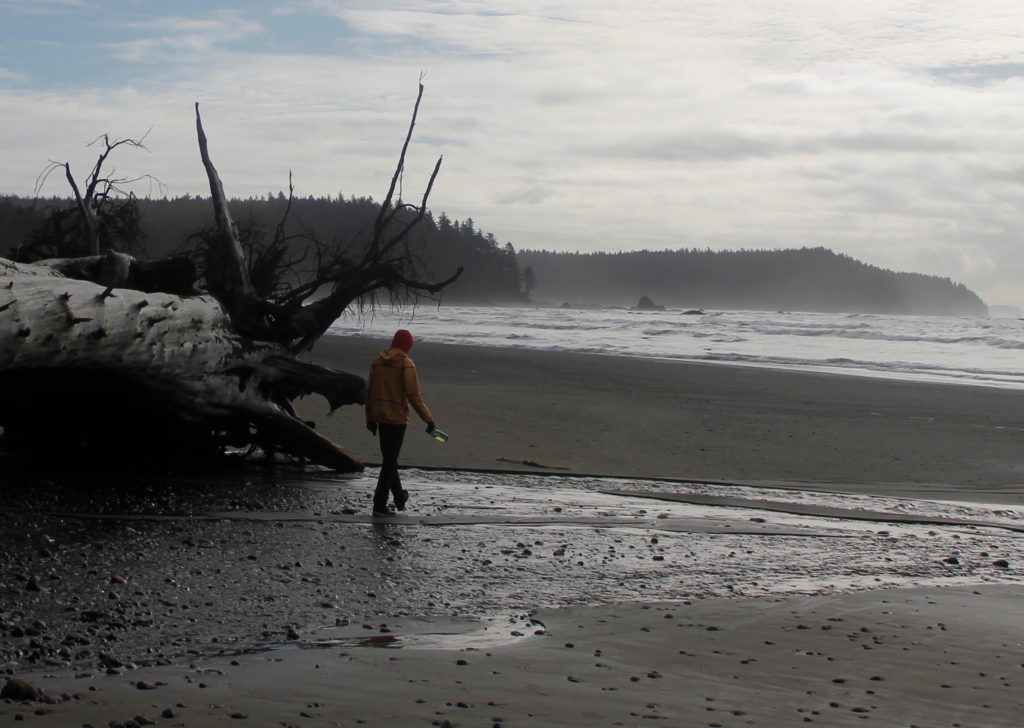
There were also abandoned buoys, tangles of nylon rope, netting, globs of shattered styrofoam blown out over the sand, countless empty bottles. Here was one of the most remote beaches in the lower United States, and yet it too was part of our trash-heap ecosystem. As Jarrett pointed out, the remoteness of the beach also meant that it didn’t have the parks and recreation department, the local volunteers and other do-gooders who would clean up the refined sands in front of a block of beach hotels.

View of the Pacific
Foam and cliffs
Big box ‘o beach trash

The lot of this did detract from the wild beauty of the beach, but fortunately, there had been plenty of wild beauty to start with. As in the night before, I had the opportunity to bask in the wonder of a vast and natural place.

We left the beach, having not explored much of it and I was fine with that.

If left some time to explore some other islands and camp spots along the lake for the next time.

Though, really, sometimes you don’t know if there will be a next time. I don’t mean that in the apocalyptic, kayaking down Wall Street sense — though I am severely concerned about the health of our planet — but mainly in terms of the ups and downs of our lives: the sickness, the health, long workweeks and yes, the reality that life is a fragile thing, easy to snuff out.

To Jarrett, who has had some close calls in his day, getting out on the water or into the mountains affirms that he is doing it right. Time outdoors is an invaluable facet of a life that also involves work he takes pride in and a committed relationship.

Keep hitting high notes, and it will be more likely that you will end on one.

It’s something I’d do well to remember.
* https://www.nps.gov/olym/planyourvisit/loader.cfm?csModule=security/getfile&PageID=96997
Guarding an Open Heart: Thoughts for Inauguration Day

“If ever I I have seen the sunrise, and known it’s time for bed, if ever I have breathed in deeply, and felt like I was dead … then I have not been, I have not been in love.” Soon or Never – The Punch Brothers.

Blessed is the half-light of a shrouded sun that peeps above the mountains. It casts a gold veneer upon the pavement outside the window, reveals itself to the jagged white edge of Klahhane Ridge, and brings tepid warmth into the room.

The morning drizzle has bedecked the winter branches with shimmering jewels of moisture, each containing an inverted world.

And yet it is all to easy to brush aside such wonders while water boils on the stovetop and the reality of a thousand crises intrudes upon my morning.

It often takes a physical act of will for me to stop and acknowledge that there is something grand and beautiful outside. Wonder doesn’t always crash into me. There are too many things to worry about for me to stumble through this world in gaping, childish awe. Yet, to disavow the capacity for awe is to throw away one of my most cherished qualities of being human. Better to force out a little love, than to leave true beauty unappreciated.

Amidst the madness and cruelty of the last year in politics, there has blown a hard prevailing wind of hard-heartedness, antipathy over compassion, othering of outsiders. The cold light of screens turned us away from our windows, from our neighbors.

Absolute ugliness, ignorance and vile self-interest dressed itself in the robes of practicality.

We’ve got to get tough. Who gives a damn about those trees anyway? You’re soft? We need jobs, not trees! You are brainwashed to want these people living in your neighborhood. They’re the worst. Don’t you know they are going to stab you in the back, when your back is turned? I know. You are going to have to work harder and sacrifice and fill your hearts with hate, but don’t worry about me. I’m trustworthy. I’m looking out for you.

Yet even those of us who smelled the con, are not immune. The stream of words have power over us too. They are meant to cow us, intimidate us and spend our energy at these provocations.

It is a victory for the bully and the trolls for us to see the world as a darker place, to miss more sunrises because we are caught up in a vomit of lies and outrages. If you were ever bullied in school, you might remember how words, through sheer power of repetition, can cause you to doubt yourself.

So are we, the enemies, told that we are useless, stupid and that we create no value.

They don’t want to convert us, they want to make us shut up and disappear. They want to tweak us into angry, foolish words, or better yet, violence, so that they can better turn their machinations against us. The ones who spit at beauty, could have no greater victory than to take the ugliness inside them and spread it around.

Make room for the “doers,” the Chevron corporation tells us in its self-congratulating advertisements, telling us there is something noble in mindless drilling, unchecked rapacity and little care about what consequences follow actions. 2016 was the third year in a row to set the record for highest global temperatures. Nice job doers! What else you got?

Politics has become personal. It will change how much snow you see upon the mountains in the morning, the plants and animals that you see. It has to do with who you see when you look at yourself in the mirror in the morning.

The fight back will be multi-tiered, taking place on the floors of congress, in the streets, in the paths of war machines, and machines that dig pipelines. It will take root in your everyday conversations with friends neighbors and families.

I hope we can protect our people, our planet and our values — just as we guard against the threat that darkness will pollute our hearts.

I, Amused

I’m not amused,
I mused,
So much as I am used to this

Amusement cycle.
The news:
Another thousand pages

Restlessly perused,
Or abused,
For cheap escape,

Only to cycle back
To the Abuser’s platform,
And the abused crying out.

Is it useless
Or — if I am used —
Useful

To a malevolent end?
I’m confused,
Typically ambivalent.

Should I jump off now,
Or clamp down
And ride this thing?

Unsealable: A Battle to Keep Water Out Of a Drysuit Becomes Obsession

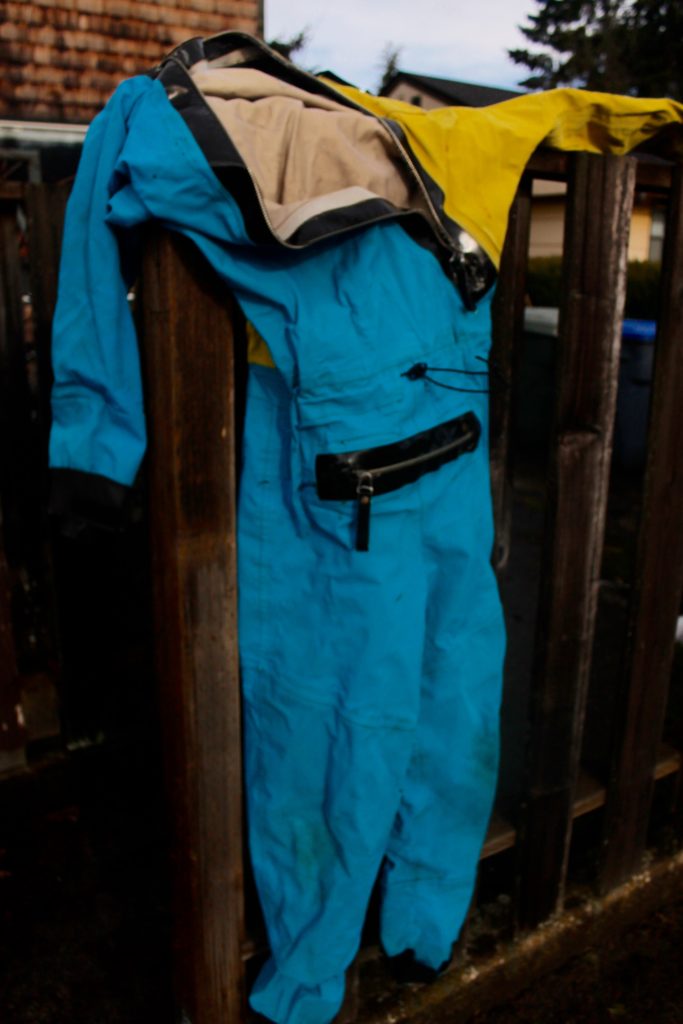
My drysuit

Whenever I felt the first icy trickle of sea-water going down my leg, my first instinct was denial.

Water couldn’t be getting in! Hadn’t I just spent the better part of a day inhaling toxic fumes as I re-glued and re-taped my drysuit seams?

Surely it was just sweat, or else moisture that was already in the suit. But I knew I was deluding myself. There was a leak somewhere. The suspicion became certainty when I’d stand up later and feel a cup of water sloshing at the bottom of each leg.

Such was the story of this summer and into fall. Every time I thought I had finally walled off every entry point, water found a way. Then I would go back with glue and tape to find the weak point in the seams, refortifying the battlements. My war against the ravages of entropy would take up much of my physical and mental energy for the months I guided kayaks.

The perfection of the drysuit was the goal that I could never quite achieve nor quite let go of.

I knew that if I finally sealed it off, it would open new horizons for my kayaking. I would be able to knock out Eskimo rolls, perform aggressive leans with my torso half-submerged, to fall out of my boat and swim through rapids — while maintaining a dry set of clothes. The old enemies, Cold, Wet and Hypothermia, would still be a threat, but I would be able to hold them off for much longer.


The freedom and security that drysuits offer comes with a hefty price tag: often around $1,000. I got mine for free by way of my dad — who’d also gotten it for free from a friend. I am not sure how old the drysuit is, though I did see a picture of the same drysuit in a book from 1999. The bulk of the suit is made from breathable Gore-Tex fabric and getting in means opening up the large waterproof chest zipper, then forcing hands, feet and head through the five different latex gaskets. The process takes several minutes, and is like giving birth in reverse. There is a relief zipper at the crotch, which is very helpful, though not so much if you’ve had a breakfast of hot oatmeal and feel a movement coming on.

When I picked up the drysuit this spring, all of the gaskets were brittle and cracked. My first project was cutting them out and then gluing new ones in their place with a special marine-grade glue called Aquaseal. This meant creating forms that mimicked wrists, ankles and neck. The place where I worked as a kayak guide had an old neck form lying around, which helped immensely. I stuffed the sleeves and legs full of newspaper.

The Aquaseal was damnably sticky and had a sharp turpentine odor. The tube warned of cancer and reproductive harm. I did the work outside to ventilate. After a few minutes of working with the stuff, I felt a bit lighter and loopy. It was good to walk away. I hoped I wouldn’t have to use it much.

I inaugurated the suit for its first test run in Port Angeles Harbor where I was teaching a friend how to Eskimo roll. The performance was spectacular. I’d put a heavy parka under the suit and was so warm that I wanted to roll over into the frigid water to cool down.

Remarkably, when I took the parka off later, I couldn’t find a drop of moisture on it! Success!


I began incorporating Eskimo rolls into my guided kayak tours. Gradually, I began to suspect that water was getting through. It’s just sweat, I tried to tell myself. Indeed, the suit was incredibly hot to work in before getting on the water, which was one reason it was good to roll over for a good soak.

Alas, my illusions vanished after a fateful run down the Elwha River. At a certain notorious rapids section, I found myself being tractor-beamed toward the exact standing wave that I had been determined to avoid. Over I went.

Though I tried desperately to come up into a roll, the thrashing water was having none of that. I pulled the sprayskirt and popped up just in time to fall over the first ledge. I spent several seconds inside a churning white room, then popped up again before yet another drop and another appointment with a white room. I came up gasping and saw a fallen tree right in my path. Swimming like mad, I almost cleared it, but not quite. I thudded against the end of the trunk with my live vest, and bounced around the last couple of feet. After I got on land and recovered my boat, I realized I was completely soaked.

It was time to twist open the tube of Aquaseal again.

Aquaseal, Tenacious Tape repair on a seam

My knowledgeable friend, Jarrett had a novel technique for finding the leak. Wearing the suit, I ran the tube of a bicycle pump into the ankle gasket and began inflating myself to sumo wrestler proportions. Then Jarrett walked around spraying the suit with a bottle full of soapy water. Sure enough, there were a couple places along the side of the suit where we could see tiny bubbles coming out.

The problem was in the seams, where the different pieces of waterproof Gore-Tex had been stitched together. The tape had begun to strip away.

I called up the people at Kokatat to ask how I might proceed. They put me through to the repair department, where a helpful man told me I was welcome to ship the suit to Arcata, California where they would take care of it. And no doubt they would do a beautiful job, but I was in no mood to wait a couple weeks.

What if I wanted to do it myself? I persisted.

The guy recommended stuff called Tenacious Tape which could be combined with Aquaseal (both products of the McNett Corporation) to make a fairly bomb-proof seam. He’d even heard of people re-taping seams with duct tape as a temporary measure.

I hung up the phone feeling encouraged. I turned my suit inside out and got to work, using scissors to cut away pieces of the peeling seam tape. I cleaned the area with alcohol and covered it over with the Tenacious Tape and Aquaseal.

The cool thing was that this worked at sealing off the area. The next time I rolled my kayak, I didn’t feel the water coming there.

However, I later discovered other leak points.


It usually took me a week or two of denying the problem to realize, yes, water was coming in through the ankle now, and then I would go back with the Tenacious Tape and Aquaseal. Both products are expensive, and I have no doubt that I spent well over a hundred dollars on them throughout the summer.

The kiss of death happened when a zipper pull tab came went off the rails. Both my boss at the kayak outfit and the people at Kokatat said that the suit was screwed. I could mail it to Kokatat and they would re-do it for $200. I had a suspicion that if I did this, they would take a look at the beater suit, laugh and tell me I should try a suit that had been manufactured in the last decade.

Meanwhile, a busted zipper meant that the drysuit was next to useless. I could buy a new one or I could go back to guiding in a Farmer John wetsuit as I had for two previous seasons. I did borrow a wetsuit for a couple of days, did an Eskimo roll, and realized that even my leaky drysuit was still way better then a Farmer John. I came up out of the water frigid, and determined to make the drysuit work.

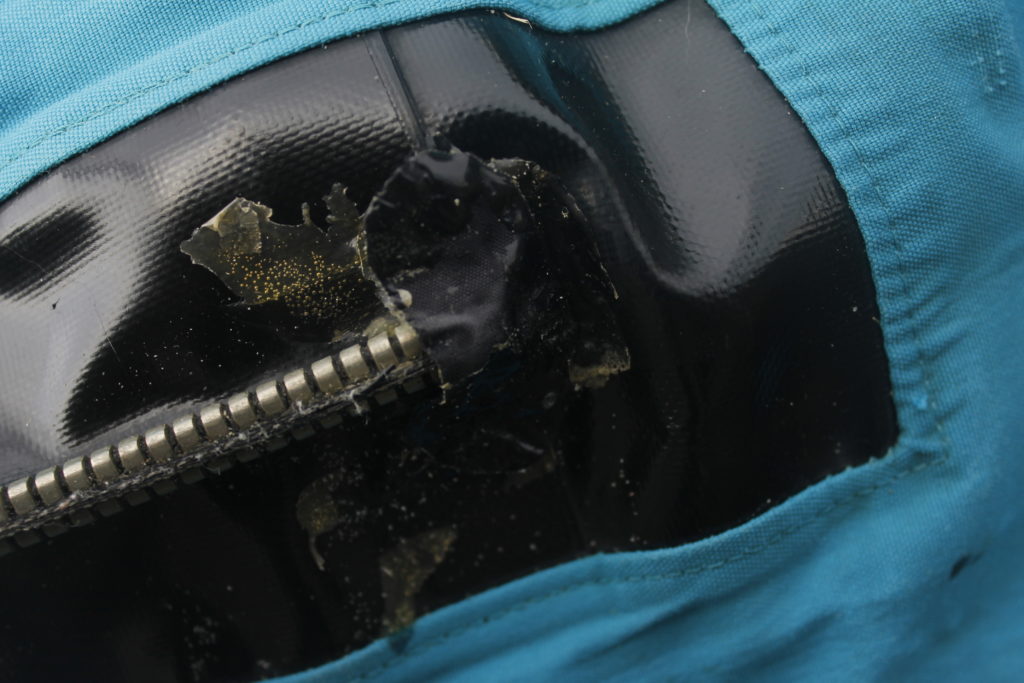
I did a little searching online for zipper repair info with mixed results. I bought a zipper repair kit from the local outdoor store and realized that I could probably work with the zipper I had if I finagled it back on. Once I got it in place, I had to glob Aquaseal and some tape back onto the ends of the zipper to make my own stopper. The fix was crude, and it was questionable as to whether it would actually keep the water out, but the first results were encouraging. I also enjoyed having my friends ask me how the hell I’d managed to get the toasted zipper back together.

But later, I found more leakage coming in. Small amounts of moisture were infiltrating. Whether it was coming through the seams or through the zipper was a good question. I reinforced both with dollops of Aquaseal.


I also reflected on how I’d known multiple people who’d owned drysuits that leaked. Indeed, knowing that drysuits have a propensity to leak in one place or another had made me hesitate to buy one to begin with.

Another kayaking friends in Port Angeles explained that he basically assumed that any drysuit he’d owned was bound to leak at some point. They were sensitive. It was easy to mess up the seam tape or poke a hole somewhere. For that reason, he tended to wear his wetsuit on routine trips and only break out the drysuit on longer distance trips or on outings where capsizing posed a serious hypothermia threat.

Being a sensitive beast, the drysuit requires all kinds of delicate care, including applying and reapplying a substance called 303 to the different gaskets so that they don’t stiffen up and break (the way my neck gasket broke when I stuck my head through it earlier this year and forced me to replace it.) After any trip involving salt water, I’d blast the suit down with a hose to get the salt off. I’ve also reapplied waterproofing spray to the outside of the suit. Vaseline on zippers helps keep them waterproof and makes it more likely that the relief zipper will open during a moment of need.

Such mindfulness exercises have been helpful to me as I work to cultivate diligence in myself and resist the urge to throw the drysuit off in a soggy heap at the end of a long day on the water.


My attempts to fortify the suit have had some success but never perfection. Water is a pernicious and determined adversary, worthy of respect.

A medieval knight might have gazed fondly upon his armor, even treasured the dings and cracks that are reminders of old battles; so do I value this Gore-Tex and latex armor that protects me from life-destroying cold. The hours I’ve invested into repairing the suit has only increased its value

I think of all the time I’ve spent and the chemicals I’ve exposed myself to just to make repairs, and it makes me think about just how much more labor and resources are required to make one of these suits. Few people who wear a drysuit are going to see the machines and people who work to put them together, but by working to repair mine, I felt as though I got a small taste of this. How much work would I be flushing down the toilet if I were to scrap the suit and buy another one?

I haven’t put the suit on for a while. Most of my winter adventures have been off the water, but I can’t help but think it would be fun to go out and see the seals again, to tool around in some January waves.

There’s a drysuit in the basement, a tube of Aquaseal in the freezer. It looks like I’ve got work to do.

Aquaseal, Tenacious Tape repair to zipper. Hmm. Looks like it could use some reinforcement.

A Doorstep Adventure From Port Angeles to the Hills


This is my first doorstep adventure post of the new year.

Starting in Port Angeles, I ran up to get some skis that I’d stashed up in the hills and climbed to the top of the foothills below the Olympic Mountains for a beautiful view and then a wild and wooly ride back down.

Since this was a doorstep adventure, I used no motors on my journey there and back again. Bringing the skis and boots up the day before was arguably the most harrowing part of the plan, wherein I pedaled an awkwardly weighted road bike over snow and ice.

This is also the first time I’ve tried adding video to my blog. The final product ain’t Herzog, but I already learned some stuff that I hope to try on the next go around. Setting up the camera and running back for it was actually kind of fun and added a new dimension to my time out.

I hope to add more video and definitely more doorstep adventure to the blog in the new year.


Daydreams and Nightmares from My 2016 Reading List.

How to Read Water: Clues and Patterns from Puddles to the Sea (Natural Navigation)

Tristan Gooley

As I lean back in my chair, my mind leaves the apartment and takes me to the deck of a Polynesian sailing vessel. I imagine lying with my back against the hard boards, eyes shut against the tropical sun. The boat rocks and pitches to the rhythm of the waves. There are clues in that rhythm that I can use to know where I am in the midst of islands that are hundreds of miles apart. I can figure out where to go.

I read about this ancient navigation method in How To Read Water, by British writer Tristan Gooley. It is a book that reveals patterns about everything from raindrops, to rivers, to the oceans and backyard puddles.

There is something very satisfying about taking something that seems random — a meandering river, say — and learn that there are laws and patterns at work. For example: a river will not flow straight for more than 10 times its width. A river will alternate between calmer pools and agitated riffles about every time the river travels a distance of five times its own width.
The fact that these are a universal law that applies to the world over calls for some awe. Indeed, I was out for a run along a brook the other day and when I counted out riffles and pools, I was amazed to see the pattern Gooley described right before my eyes.

The experience confirmed my belief that a book worth reading is one that you can put down and then go out and see the world, even a little bit differently.

Take glitter paths. The term refers to the flashing off the waves you see with sunrise, sunset, or any other light that’s low over the water.

While the the paths are beautiful enough for most of us to take a picture, we may not notice or understand why the corridor of light often bulges outward as it approaches shore. This is because the waves get higher closer to the beach as they enter shallow water.

I had never noticed this about glitter paths, but video game developers have, and will sometimes put it in their graphics. The irony is that this concept, which many of us never recognize in real life, can add verisimilitude to a fake world.
Understanding the nature of wave patterns was a crucial part of inter-island navigation for  Polynesians who had no compasses, much less the GPS and Google Maps that ease day to day navigation for us moderns.

The waves gave them the clues they needed, ones they could read by feel, laying on their backs. To imagine how this works, picture a group of rocks in the path of a steady line of waves, the waves are going to bounce and bend around the rocks in a certain pattern. Now instead of rocks, think of islands. They too cause waves to bounce and bend, to crisscross each other in certain places. Navigators in the Marshall Islands were able to exploit this pattern and could tell where they were simply by the way the waves felt beneath the boat. It took years of training. The islanders used stick diagrams to model the way that the waves moved through the island group.

Unsurprisingly, this type of navigation is a dying art, as there are plenty of other, easier ways to get from island to island..

There are still a few who can pull off the trick, however. An excellent New York Times piece describes a modern expedition that found its way through wave navigation here:

Gooley’s book, reinforced for me that meaning and richness are intermingled with the seemingly mundane trinkets like the shape of ripples or the nature of waves. Such thoughtful observation is all the more poignant now as popular awareness of nature declines, and the virtual world — with its expertly rendered glitter paths — beckons. There is much worth learning from Gooley’s careful insight into the quiet profundity of these relationships.

The Emerald Mile: The Epic Story of The Fastest Ride in History Through The Heart of The Grand Canyon 

Kevin Fedarko

Profound, which literally means deep, is definitely an appropriate word for the Grand Canyon.

Kevin Fedarko’s book The Emerald Mile, took me down below the canyon walls to the Colorado River, where it runs fast, narrow, treacherous, through monster, boat-ripping rapids. At the center of the book lies an insane quest by three dirtbag river boaters who illegally launched a fragile wooden dory at the head of the Grand Canyon during a massive, unprecedented water release from Glen Canyon Dam in 1983. The men had years of experience guiding professional boat tours in the canyon, but they knew that this time the river would be wilder and more dangerous than anything they’d ever encountered. Their goal: to set the record for the fastest decent through the 277 miles of canyon.

Like a river, the book has sections that provide high action, others that are suitable for contemplation: i.e. the history of dam building in the canyon, the demands that an expanding West place upon the watershed, a thorough explanation of the El Niño system that brought so much water down the Colorado that the structural integrity of Glen Canyon Dam itself was in doubt,

I particularly enjoyed Fedarko’s character study of the man behind the speed run, Kenton Grua, for whom the descent was less about macho oneupmanship and more about doing things right. 

Perfectionism is a common trait I’ve seen among river guides (don’t let the scraggly beards and crushed cans of PBR fool you.) This makes sense considering that many rapids will not forgive half-measures or sloppy calculation. Off the water, guides will apply the same exactitude for managing gear or making dinner. The rough edges of each operation hone down toward optimal efficiency over many trips, many seasons on the water. One guide’s idea of perfect is not necessarily the same as another’s though.

“You’re doing it wrong,” was an unofficial slogan at the raft company where I worked. As a newbie, I heard it a lot.

Therefore, Grua’s profile as “an incorrigible evangelist” and “pain in the ass,” rang true to me. Invariably, he told the other guides how they should load the boats or boil coffee in the morning. I’m sure he was annoying. His determination to do everything the best way possible also lead to amazing things.

He became the first known person to hike the length of the Grand Canyon. He had to do it right because somebody else hadn’t. The British author, Colin Fletcher wrote about his own, shorter hike within the original boundaries of Grand Canyon National Park. But the National Park was not the whole canyon, and that was a sticking point for Grua, who decided to do it to the last mile. The Grand is no mere 277 mile hike; it is a puzzle that involves knowing which shelf to walk on to avoid dead ends, finding water, and negotiating sliding talus slopes above 1,000-foot drop-offs. Grua did the whole thing.

Unlike the Brit who had irked him, Grua never bothered publicizing his achievement. “For him, it was sufficient that he had made good on his declaration that somebody needed to do it right,” Fedarko writes.

That same motivation, seemed to be what motivated him to try to set the record for fastest time through the canyon on a boat. Grua’s speed run through the Grand, was illegal but it did it right on several levels.

While he and his two buddies didn’t quite get Park Service permission for their trip, they did take the speed record away from a motorboat, validating human power over engine power.

The trip also did it right because they were taking on the river during a large dam release, and therefore experiencing what the old, untamed Colorado would have been like, before the dams went in. The damming of the Colorado is basically Original Sin for river guides and for western environmentalists like Edward Abbey. The Glen Canyon Dam didn’t just drown a canyon of unparalleled beauty, it also cheated others of the opportunity to ride rapids the way John Wesley Powell did when he led the first U.S. expeditions through the canyon.

The dam neutered the river from its once mighty heights. But when the 1983 El Niño forced the engineers at Glen to release water, the old wild Colorado reawakened and the three guides had a chance to recognize and respect the real strength of the river.

It almost cost them their lives at Crystal Rapid, where their boat flipped over on a monster wave —  “the biggest mess of whitewater that any Grand Canyon boatman, living or dead, had ever seen.” While the men thrashed inside the chaos, the nose of the dory slammed one of them right between the eyebrows.

Somehow everyone survived, and what’s more, a weary and beleaguered crew finished the run.

By riding out the river at its most violent, they set a time of of 36 hours and 38 minutes. Their non-motorized speed record would hold until this year, when several kayakers took a stab at it.

The title went to a 25-year-old Denver man named Ben Orkin who paddled a sea kayak down in 34 hours and two minutes this January. https://www.outsideonline.com/2051171/how-grand-canyon-speed-record-was-broken-twice-three-days.

I was pleased to read that Orkin also beat a motorized record from the ’90s, keeping the best canyon times in favor of human power. As the article in Outside notes, Orkin was able to set the record, even though there wasn’t the same epic amount of water coming down the river that had propelled Grua’s crew. The sea kayak moves faster in the water than a dory, though it is probably more vulnerable to capsize in whitewater.

Going back to the theme of “doing it right,” some will debate whether either of these record setting runs were noble, or foolish, vainglorious enterprise. Grua’s trip was actually illegal. Both records involved far more danger than the typical adventure down the canyon and might have triggered an expensive rescue. Like Grua, Orkin capsized in a rapid, an event that could have proven fatal.

I’m a romantic, so for me, both trips were “doing it right.” They accepted risk and hardship, and neither was obnoxiously self-promoting like many Red Bull stunts. The adventurers I respect most know that simply summiting or setting the fastest time is secondary, it’s how they do it, that interests me most of all. Adventure, like art, is an opportunity to exercise your values.

Established codes like Leave No Trace or the Ten Essentials lay out commandments for travelers to follow, but there is still plenty of room for personal judgement.

Is it better to build a small campfire or carry a gas stove? Better to carry in food on a long canoe trip or take fish from the (limited) natural environment? Is a GoPro a valuable documentation tool, or a distracting intrusion? Should the video be set to music by Jose Gonzalez or Daft Punk?

My personal code factors in carbon emissions. I will often eschew a far-flung adventure for a local one, and consider the doorstep adventure to be the best of all.

Thinking about these things (or even obsessing about them) cultivates thoughtfulness in an adventurer and adds a layer of meaning to their endeavors. Adventurers ask a lot from the wild places: they seek inspiration, purpose and to fill their hearts with beauty. The best know how important it is to give back, and that humility, that giving also becomes their reward.

The Story of Stuff 

Annie Leonard

It is a worthy goal to try and understand and respect the stories woven into rivers and canyons, but what about your smartphone’s story? Do you know the stories of the clothes you are wearing, the computer you are reading off of, the bottle you are drinking from? Do you want to know?

True, there are plenty of articles, books and documentaries that trace the origins of consumer commodities, revealing that (surprise, surprise) many of these goods arise from horrific exploitation like sweatshop labor, dangerous mines, or factories that spew toxic waste. What makes Leonard’s book rise to the top of the field is thoroughness. As a decades-long Green Peace activist, and now current head of the American branch of the organization, she has travelled around the world and witnessed the real stories behind the closeout price-tag. Often they are stories of environmental abuse, human rights violation, and exploitive development policy wherein rich countries tell poor ones how to run their economies.

On the home front, Leonard details the psychological price that consumerism has had on Americans, including more hours spent at work to keep the credit cards paid for, and less time spent enjoying family or building community.

To change those dynamics, she details ways to be a better consumer (buy less stuff and make it last) advocates for community groups and lobby the government for a policy that minimizes stuff.

To read Leonard’s book is to become skeptical of many purchases — and realize that there is always room for improvement. I used to feel virtuous for buying beer in cans instead of bottles, as cans take less energy to recycle. Leonard tweaked me here, because it turns out that manufacturing aluminum takes lots of energy and produces a lot of carbon dioxide. Recycling that aluminum also comes with a high energy cost. I haven’t bought as much beer recently.

Leonard is a big fan of bulk foods, something I try to support when I bring old oatmeal and peanut butter containers to the store to refill.

She also guns for government policy that makes corporations that make the waste pay for the disposal. Transfer stations will make you pay to throw out that old fridge with toxic coolant in its tubes, but really, shouldn’t the company that made the fridge bear the costs of disposal instead of you, the consumer? Cradle to grave responsibility is the idea. There are companies that make frivolous packages, toxic products that are next to impossible to untangle and products designed to be impossible (or damn near it) to repair. These companies should have to pay at the transfer station; not the consumer, not the city electronic waste recycling program and not the environment. If the manufacturers had to bear the costs of disposal, it would encourage them to make products that have fewer toxins, are easier to recycle, have less packaging and last longer.

She also favors more shared goods in society, such as car sharing, and the library near her home in Berkeley, that will loan out ladders and repair tools. More companies could offer to lease their goods, she believes, and there would be more incentive for them to build things to last and offer comprehensive repairs.

There is no question that such proposals swim against the tide of popular economic theory and globalization, which encourage more trade and more production. Metrics like Gross Domestic Product measure a nation’s success based on the amount of stuff it produces, with no attempt to measure the health or happiness of the population, never mind the health of the ecosystems.

Leonard castigates the World Bank and World Trade organization who have loaned money to poor countries on the condition that they knock out subsidies or tariff protections for farmers. Uprooted from the land, they go to work in urban sweatshops, making tchotchkes that find their way to the local department store.

Such policies also led to famine in Haiti, when the displacement of rice farmers  (many of whom ended up in garment factories) caused the country to depend on imports — a disastrous dependence when a drought in Australia jacked up the cost of imported rice.

The market has meant the most developed countries like America importing goods from abroad while exporting the social and environmental consequences to somewhere where there are looser regulations.

Now Trump promises to put his shoulder against this tide of commerce and bring manufacturing industries back to America. Between the backpedaling he’s made on previous promises and the billionaire cast of corporate raiders he’s picked for his cabinet, I have my doubts about this. Suppose the industries did come back, though. In that case, a hamstrung and mismanaged Trump EPA would likely allow them to start dumping sludge in the rivers and carcinogens in the air — America would start to look more like the wastelands overseas where its manufacturing happens now.

Whether or not something has a Made in China sticker or a Made in America sticker, the fact that much of what we buy ends up neglected or on the curb indicates that plenty of stuff just shouldn’t be made at all.

Advertising and consumer culture work overtime to create need, to keep the wheels turning, but this is no recipe for happiness, Leonard says. We just have to work harder to buy everything, and that means less time and energy spent on what matters.

“Relationships with family, peers, colleagues, neighbors, and community members have proven over and over to be the biggest determining factor in our happiness, once our basic needs are met,” she writes. “Yet because we’re working more than ever before to afford and maintain all this Stuff, we’re spending more time alone and less time with family, with friends, with neighbors.”

Those who try to live simple, sustainable lives must make sacrifices, but perhaps those sacrifices are not so great as the choice to live one’s life, unexamined, in endless want, roaming the aisles in search of some product to dull the dissatisfaction for a moment.

Purity: A Novel

Jonathan Franzen

One thing I admire about Jonathan Franzen’s fiction is that he is a big-picture guy. Human overpopulation is an important issues that most contemporary books  I’ve read tend to avoid, or mention in a perfunctory manner. But Franzen managed to fit that concept into a novel that wide-ranging, but also personal with his 2010 book Freedom.

Last year, he wrote Purity, which took on a similarly ambitious subject: the Internet’s power to dissolve secrecy, a theme that is all too familiar in the wake of the U.S. presidential election. Franzen also looked at authoritarian undercurrents within the Internet, where the exchange of ideas often gives way to groupthink.

The antagonist of the story, Andreas Wolf, is a figure in the mold of Assange who runs a Wikileaks-type organization exposing international scandals and corrupt governments. Despite the fact that his organization has exposed wrongdoers, Wolf does so selectively, choosing to ignore whistleblowers that give him big leads on abuses by Google and other tech companies — those are the enemies that he cannot afford to turn against. He is no idealist about the future of the Internet; rather, he sees it as an incarnation of the totalitarian East Germany where he grew up.

“If you substituted networks for socialism, you got the Internet,” Wolf thinks. “Its competing platforms were united in their ambition to define every term of your existence.”

Indeed, Facebook has surveillance powers that would have made Stalin proud. We may not have a commissar to confess to, but the phone is always on the table, waiting for the next post. Whether your online buddies are safe-space micro-aggression chroniclers or Cliven Bundy sympathizers who will tell you why their racism is not racist, you will always be aware that every view you post will be subject to their scrutiny and pressure to tell them what they want to hear.

Online publications play the same games. Selling clicks has been great business for echo chambers like The Huffington Post on the left and Breitbart on the right: the brave new media, that feed people views they already agree with.

“The aim of the Internet and its associated technologies was to “liberate” humanity from the tasks,” Franzen writes. “—Making things, learning things, remembering things—that had previously given meaning to life and thus had constituted life. Now it seemed as if the only task that meant anything was search-engine optimization.”

Franzen contrasts the self-aggrandizing Wolf with Tom Abberant, a dyed-in-the-wool journalist he befriends, but later seeks to destroy. Why? Because Abberant knows a dirty secret that could ruin him. The hypocrisy of someone who tells other people’s secrets, holding on to his own is damning, but hardly unexpected.

Abberant is also his rival as a standard bearer for the old guard of journalism, that his brand of leak-based news has begun to displace. Journalism in Purity, as in real life, is a dying field.

A young woman named Purity — nicknamed Pip — works for both men and sees the world through their competing visions. She is literally the younger generation in the story, awash in student loan debt and struggling to find meaningful employment. She also is determined to find out who her father is, a question that draws her to Wolf in hopes that he can find him for her. The desire to uncover secrecy motivates her, but Wolf sees this as an opportunity to mobilize her against his enemy, Abberant.

As in the spy masters of the Cold War, Wolf power is contingent on revealing his enemy’s secrets while withholding his own.

In the last decade, we have seen the Internet’s power to unmask secrets brought to bear on politicians, corporations, celebrities, on average people. This year, leaked video and leaked emails hounded the campaigns of Donald Trump and Hillary Clinton respectively. Voters (including me) were more interested in what the candidates had to hide about themselves, then what they trumpeted about themselves. Discovering their secrets was more entertaining than going down a list of their policy points.

Yet, these revelations had their own agenda. I remember going to the Wikileaks website shortly after hacked emails from the Clinton campaign came out. Julian Assange had written a piece defending his decision to publicize the emails, even though this would clearly help the campaign of the most undemocratic candidate in U.S. history. Assange basically said, Hey, If I had some dirt on Trump, I’d release it, but right now, I’ve got dirt on Hillary. In other words, Wikileaks is just a neutral medium, like a pane of glass that makes no decisions about what it puts out — a lovely abdication of editorial responsibility. Too bad that Russia decided to use that outlet as a tool to advance its own agenda.

To those who believe that it is best for the media is best served as an impartial mediator between two sides, Franzen disagrees. “Filtering isn’t phoniness — it’s civilization,” he writes. Good writing is an example of an author focusing in on specific aspects of an issue. A good photograph is cropped to focus on what the photographer sees as important.

Media outlets do have the power to put information into context, and arguably that is the more important part of their job. One way the media could have thrown the hack into context would have been to highlight suspicions that the hack was Russia backed and asked why. The question gained steam after the election when it was too late to change anything. Yet the illicit thrill of finding out a secret was more newsworthy at the time.

It is tempting, but misleading, to believe that we are living in a utopian era of total information access. A look at the world today, tells me that the power to twist the information, and to continue to conceal, is more powerful than the information itself. All the reams of information in the world about Global Warming is worth nought if the likes of Donald Trump simply repeat that Global Warming is a hoax. We have no idea what his tax returns are either.

Still, the constant drip-drip-drip of information from the Internet can convince us that we are busy, that we are learning things and advancing knowledge —distracting us while the ship veers off its course and into the path of a deadly reef.

I think back to one of the ancient Marshall Islands boat navigators Tristan Gooley describes in How to Read Water.  They might have have perceived a reef beneath the surface of the water because of the way the waves felt. They did this by closing their eyes: too much information would distract them.

In the year to come, I believe that it would profit me, and many others to adopt a similar selectiveness when it comes to understanding the world. Sometimes it is better to close your eyes, so that you can think about the information you already have, instead of constantly absorbing new data and not thinking about what it means.

We have an unprecedented ability to acquire information, but sometimes it is more of a distraction than a help.